
The fall window
How to Overseed Your Lawn This Fall
Fall is the most reliable window for overseeding a cool-season lawn: warm soil for fast germination, cooling air and fading weeds for an easy start, and enough mild weeks left to root before winter. The job is the same for every cool-season grass — mow low, open the soil, seed, and keep it moist — so it's written out once below, followed by what actually differs for your grass: how fast it germinates, how short to mow it, and how much nitrogen it runs on.
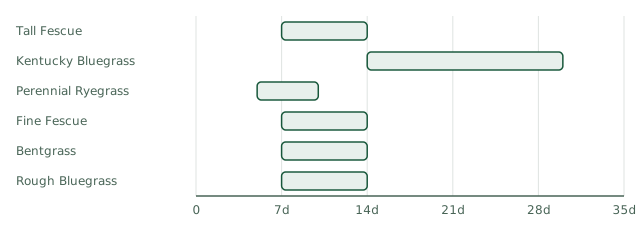
When to overseed
Seed about 6–8 weeks before your average first fall freeze — the colder your zone, the earlier that lands. Expect first seedlings in roughly 5–30 days in warm fall soil depending on the grass, and keep the top inch damp for every one of them.
A zone number is a rough cut at a date that is really set by your local freeze normals. Overseeding dates by zone or state works them out from the NOAA record.
Step by step
Overseeding takes the same six steps for every cool-season grass. Where a number depends on the grass, it is given as the range across all of them — your grass's own figure is in its section below.
- Step 1
Time it for late summer into early fall
Time a cool-season overseed for roughly 6–8 weeks before your first fall frost, when the soil is still warm but nights are cooling. The late-summer overseeding window gives seed warm soil to germinate in and enough cool, mild weeks to root before winter — the colder your USDA zone, the earlier it falls. Soil temperature, not the calendar, has the final say.
- Step 2
Mow low, then open up the soil
New seed has to reach actual soil to take. Mow a little shorter than usual — cool-season lawns come down toward 0.25–2.5" depending on the grass (your grass's number is in its section below) — and bag the clippings, then rake out thatch and debris and core-aerate so the seed can settle into real soil contact instead of perching on the canopy.
- Step 3
Spread seed at the right rate and work it in
Use quality seed matched to your existing lawn and follow the bag's overseeding rate — more is not better; too-thick seed competes with itself and damps off. Spread it evenly with a spreader, then lightly rake or topdress so it's in firm contact with the soil but not buried.
Match the seed to your conditions (sun vs. shade) and follow the rate on the bag — the seed label is the authority on coverage.
- Step 4
Keep it consistently moist until it germinates
Keep the top inch moist, not saturated. Light watering is usually needed daily, often two or three or more times in warm, sunny, dry or windy weather. Check throughout the day; actual rain can reduce or replace watering. As seedlings emerge across the area, grow and root, gradually water less often and more deeply, protecting slower species in a mix. A few mowings of the new grass mark progress toward established watering, not the start of tapering.
- Step 5
Feed for establishment, then for fall
Give the new seedlings a gentle starter feeding to fuel root growth, then fold into the normal fall program — fall is when most programs feed a cool-season lawn. Annual nitrogen planning ranges across these grasses run 1–4 lb per 1,000 sq ft; yours is in its section below. Build the lawn's roots now and it green-ups vigorously in spring.
Plan about 1 lb of nitrogen per 1,000 sq ft per feeding or less — a conservative default, not a universal limit. Local fertilizer rules can be stricter than this and can override it: several states and counties set a lower per-application limit, cap the soluble (quick-release) fraction separately, require a share of slow-release nitrogen, or ban applications outright during a seasonal blackout. Check your state or county rules before you spread. Always read and follow the product label — it is the legal authority on rates, timing, and safety. These windows are regional estimates, not a prescription; defer to the label and your local extension office.
- Step 6
Check crabgrass-preventer compatibility before seeding
Many crabgrass preventers can injure seedlings or prevent the new grass from establishing.
Most conventional pre-emergents can injure seedlings or prevent establishment. Before seeding treated ground, follow the exact product's reseeding interval for the rate used; waits are often months, not weeks. Before treating newly seeded grass, follow its separate waiting, mowing and establishment requirements. Use a product at seeding only when its label allows your grass species, seed mixture, rate and timing. For crabgrass prevention while seeding cool-season grass, mesotrione products with new-seeding directions are an option only for the existing turf and seed mixture that product lists. Species and timing differ by product, especially for fine fescue; avoid over-application, particularly with perennial ryegrass.
Handle broadleaf weeds only once the seedlings are well established.
Check product compatibility before combining seeding and weed prevention.
Most conventional pre-emergents can injure seedlings or prevent establishment. Before seeding treated ground, follow the exact product's reseeding interval for the rate used; waits are often months, not weeks. Before treating newly seeded grass, follow its separate waiting, mowing and establishment requirements. Use a product at seeding only when its label allows your grass species, seed mixture, rate and timing. For crabgrass prevention while seeding cool-season grass, mesotrione products with new-seeding directions are an option only for the existing turf and seed mixture that product lists. Species and timing differ by product, especially for fine fescue; avoid over-application, particularly with perennial ryegrass.
Always read and follow the product label — it is the legal authority on rates, timing, and safety. These windows are regional estimates, not a prescription; defer to the label and your local extension office.
Where does the pre-emergent window fall for you?
Many pre-emergents can injure new grass. Check the exact product's reseeding interval and separate new-turf requirements before combining seeding and prevention. Enter your ZIP in the free pre-emergent check to see when the crabgrass window opens near you — no signup required.
Check my pre-emergent windowBy grass type
Each grass section below gives four numbers and one comparison — how fast the grass comes up, how short to mow it, what it runs on, and where it sits against the alternatives you are probably weighing.
How to Overseed a Tall Fescue Lawn in Fall
Tall Fescue is bunch-type, so overseeding is the only way to fix thin and bare spots.
- Germination
- 7–14 days
- Mow down to
- 2.5"
- Annual nitrogen (planning range)
- 3–4 lb
- Growth habit
- Bunch-type
Zones 4–7 · nitrogen is lb per 1,000 sq ft per year
Tall fescue is 2nd of 6 on germination speed, at 7–14 days — against perennial ryegrass's 5–10 at the quick end and kentucky bluegrass's 14–30 at the slow one. That is long enough that the seedbed has to stay damp through more than one weather pattern, and short enough that a late start is still recoverable.
Tall fescue's case against the alternatives is drought (better than 4 of the other 5). It is bunch-type, so it never fills a bare patch sideways — overseeding is the only way that spot closes, which is why the seeding rate matters more here than on a spreading grass.
On the map, tall fescue is grown in zones 4–7. That is the narrowest range here, so it is a deliberate choice rather than a default: outside those zones a blend leaning on something hardier will do better. Where you have a choice, kentucky bluegrass, perennial ryegrass and fine fescue overlap it and are worth comparing before you buy — a blend is usually a better answer than a single species anyway.
How to Overseed a Kentucky Bluegrass Lawn in Fall
Kentucky Bluegrass spreads on its own — overseeding in fall just gets it thick faster.
- Germination
- 14–30 days
- Mow down to
- 2.5"
- Annual nitrogen (planning range)
- 2–4 lb
- Growth habit
- Spreading (self-repairing)
Zones 3–7 · nitrogen is lb per 1,000 sq ft per year
Kentucky bluegrass is the slowest of the 6 grasses here to come up, at 14–30 days — against perennial ryegrass's 5–10 at the quick end and kentucky bluegrass's 14–30 at the slow one. That long tail is the whole reason this page keeps returning to watering: a seedbed has to stay damp for the entire window, and every extra day is another day it can be lost to one hot afternoon.
Kentucky bluegrass's case against the alternatives is traffic (better than 4 of the other 5), and the argument against it is shade, where tall fescue, perennial ryegrass and fine fescue all do better. It also spreads on its own, so an overseed is a head start rather than the only repair mechanism you have.
On the map, kentucky bluegrass is grown in zones 3–7. That is the widest range in this family, which is why it turns up in so many blends — it is rarely the wrong answer even where it is not the best one. Where you have a choice, tall fescue, perennial ryegrass and fine fescue overlap it and are worth comparing before you buy — a blend is usually a better answer than a single species anyway.
How to Overseed a Perennial Ryegrass Lawn in Fall
Perennial Ryegrass is bunch-type, so overseeding is the only way to fix thin and bare spots.
- Germination
- 5–10 days
- Mow down to
- 1.5"
- Annual nitrogen (planning range)
- 2–4 lb
- Growth habit
- Bunch-type
Zones 4–7 · nitrogen is lb per 1,000 sq ft per year
Perennial ryegrass is the fastest of the 6 grasses in this family to come up, at 5–10 days — against perennial ryegrass's 5–10 at the quick end and kentucky bluegrass's 14–30 at the slow one. Coming up fast is a real advantage in a late seeding and a real trap in an early one — it tempts you to stop watering while the roots are still in the top inch.
Perennial ryegrass's case against the alternatives is traffic (better than 4 of the other 5). It is bunch-type, so it never fills a bare patch sideways — overseeding is the only way that spot closes, which is why the seeding rate matters more here than on a spreading grass.
On the map, perennial ryegrass is grown in zones 4–7. That is the narrowest range here, so it is a deliberate choice rather than a default: outside those zones a blend leaning on something hardier will do better. Where you have a choice, tall fescue, kentucky bluegrass and fine fescue overlap it and are worth comparing before you buy — a blend is usually a better answer than a single species anyway.
How to Overseed a Fine Fescue Lawn in Fall
Fine Fescue is bunch-type, so overseeding is the only way to fix thin and bare spots.
- Germination
- 7–14 days
- Mow down to
- 2.5"
- Annual nitrogen (planning range)
- 1–2 lb
- Growth habit
- Mixed — bunch-type with creeping (rhizomatous) reds
Zones 3–7 · nitrogen is lb per 1,000 sq ft per year
Fine fescue is 3rd of 6 on germination speed, at 7–14 days — against perennial ryegrass's 5–10 at the quick end and kentucky bluegrass's 14–30 at the slow one. That is long enough that the seedbed has to stay damp through more than one weather pattern, and short enough that a late start is still recoverable.
Fine fescue's case against the alternatives is shade (better than 4 of the other 5), drought (better than 4 of the other 5), and the argument against it is traffic, where tall fescue, kentucky bluegrass and perennial ryegrass all do better. It is bunch-type, so it never fills a bare patch sideways — overseeding is the only way that spot closes, which is why the seeding rate matters more here than on a spreading grass.
On the map, fine fescue is grown in zones 3–7. That is the widest range in this family, which is why it turns up in so many blends — it is rarely the wrong answer even where it is not the best one. Where you have a choice, tall fescue, kentucky bluegrass and perennial ryegrass overlap it and are worth comparing before you buy — a blend is usually a better answer than a single species anyway.
How to Overseed a Bentgrass Lawn in Fall
Bentgrass spreads on its own — overseeding in fall just gets it thick faster.
- Germination
- 7–14 days
- Mow down to
- 0.25"
- Annual nitrogen (planning range)
- 1–2 lb
- Growth habit
- Spreading (self-repairing)
Zones 3–7 · nitrogen is lb per 1,000 sq ft per year
Creeping bentgrass is 4th of 6 on germination speed, at 7–14 days — against perennial ryegrass's 5–10 at the quick end and kentucky bluegrass's 14–30 at the slow one. That is long enough that the seedbed has to stay damp through more than one weather pattern, and short enough that a late start is still recoverable.
The argument against creeping bentgrass is shade, where tall fescue, perennial ryegrass and fine fescue all do better. It also spreads on its own, so an overseed is a head start rather than the only repair mechanism you have.
On the map, creeping bentgrass is grown in zones 3–7. That is the widest range in this family, which is why it turns up in so many blends — it is rarely the wrong answer even where it is not the best one. Where you have a choice, tall fescue, kentucky bluegrass and perennial ryegrass overlap it and are worth comparing before you buy — a blend is usually a better answer than a single species anyway.
How to Overseed a Rough Bluegrass Lawn in Fall
Rough Bluegrass spreads on its own — overseeding in fall just gets it thick faster.
- Germination
- 7–14 days
- Mow down to
- 2"
- Annual nitrogen (planning range)
- 2–4 lb
- Growth habit
- Spreading (self-repairing)
Zones 3–7 · nitrogen is lb per 1,000 sq ft per year
Rough bluegrass is 5th of 6 on germination speed, at 7–14 days — against perennial ryegrass's 5–10 at the quick end and kentucky bluegrass's 14–30 at the slow one. That is long enough that the seedbed has to stay damp through more than one weather pattern, and short enough that a late start is still recoverable.
Rough bluegrass's case against the alternatives is shade (better than 4 of the other 5), and the argument against it is traffic, where tall fescue, kentucky bluegrass and perennial ryegrass all do better. It also spreads on its own, so an overseed is a head start rather than the only repair mechanism you have.
On the map, rough bluegrass is grown in zones 3–7. That is the widest range in this family, which is why it turns up in so many blends — it is rarely the wrong answer even where it is not the best one. Where you have a choice, tall fescue, kentucky bluegrass and perennial ryegrass overlap it and are worth comparing before you buy — a blend is usually a better answer than a single species anyway.
What not to do
- Overseeding in spring or summer — fall germination and rooting are far stronger.
- Applying a crabgrass preventer near seeding without checking its reseeding and new-turf label requirements.
- Letting fresh seed dry out — that's the most common reason an overseed fails.
- Burying seed deep or piling it on too thick, which leaves it to rot or compete with itself.
Overseeding questions, answered
- When should I overseed?
- Overseed a cool-season lawn roughly 6–8 weeks before your average first fall frost — late summer into early fall for most of the country, and earlier the colder your USDA zone. Soil temperature has the final say: seed goes down while the soil is still warm enough for fast germination but the air has started to cool. Seeding too late leaves seedlings without enough mild weeks to root before winter.
- How long does grass seed take to germinate?
- Grass seed germination time depends on the grass: 5–30 days to first seedlings across the cool-season grasses in warm fall soil, with perennial ryegrass at the fast end and Kentucky bluegrass at the slow end. Each grass's range is in its section below. That whole stretch is when the top inch of soil must not dry out — a single hot, dry afternoon during germination is the most common reason an overseed fails.
- Do I have to aerate before overseeding?
- Core-aerating before overseeding is not strictly required, but seed has to reach actual soil to take, so anything that gets it past the canopy helps a lot. The reliable order is: mow short — toward 0.25–2.5" depending on your grass — bag the clippings, rake out thatch and debris, then core-aerate and seed into the holes and loosened surface.
- Can I put down crabgrass pre-emergent when I overseed?
- A crabgrass pre-emergent generally should not go down on ground you are overseeding. Most conventional pre-emergents can injure seedlings or prevent establishment. Before seeding treated ground, follow the exact product's reseeding interval for the rate used; waits are often months, not weeks. Before treating newly seeded grass, follow its separate waiting, mowing and establishment requirements. Use a product at seeding only when its label allows your grass species, seed mixture, rate and timing. For crabgrass prevention while seeding cool-season grass, mesotrione products with new-seeding directions are an option only for the existing turf and seed mixture that product lists. Species and timing differ by product, especially for fine fescue; avoid over-application, particularly with perennial ryegrass. Always read and follow the product label — it is the legal authority on rates, timing, and safety. These windows are regional estimates, not a prescription; defer to the label and your local extension office.
- Can I overseed in spring instead of fall?
- A lawn can be overseeded in spring instead of fall, but spring is the harder path. Fall gives seedlings warm soil, cooling air, fading weed pressure, and a full mild stretch to root; spring seedlings race summer heat and compete with crabgrass. Before combining spring seeding and a crabgrass preventer, check the exact label for your species, mixture, rate and stage. If the lawn is thin now, fall is worth waiting for.
- How much should I feed a new overseed?
- Feed a new cool-season overseed with a gentle starter feeding at seeding to fuel root growth, then fold into the normal fall program, which runs on a 1–4 lb annual nitrogen budget per 1,000 sq ft depending on the grass. Plan each feeding at about 1 lb of nitrogen per 1,000 sq ft or less (a conservative default, not a universal limit), and split the budget across the season instead. Local fertilizer rules can be stricter than this and can override it: several states and counties set a lower per-application limit, cap the soluble (quick-release) fraction separately, require a share of slow-release nitrogen, or ban applications outright during a seasonal blackout. Check your state or county rules before you spread. Always read and follow the product label — it is the legal authority on rates, timing, and safety. These windows are regional estimates, not a prescription; defer to the label and your local extension office.
One fall overseed sets up next year's lawn
Follow through after sowing: keep the seedbed moist through germination and early growth, then taper watering as roots develop, allowing for slower species in a mix and adjusting for soil moisture and weather. Also plan for the season after that, when a routine crabgrass pre-emergent would quietly undo the whole thing. If you'd rather start from the year's basics, the lawn care schedules by grass type are the foundation this renovation sits inside.
Where this guidance comes from
The university extension and public-agency publications listed here back specific statements on this page. Each publication says which statement it backs, so you can check the statement rather than take it on trust. Where a product label or your local extension office disagrees with anything here, follow the label or the extension office.
- Lawn Establishment
Penn State Extension
Fall is the season to overseed a cool-season lawn: warm soil speeds germination, weeds fade, and seedlings get the cool fall and spring to root before summer stress.
- Establishing Turfgrass Areas From Seed (AY-3-W)
Purdue University Turf Science
Late summer into early fall is the best time to seed cool-season grasses, and seeding early in that window rather than late is what gives seedlings time to establish.
- Seeding and sodding home lawns
University of Minnesota Extension
Seed has to be in firm contact with soil and kept consistently damp with light, frequent watering until it germinates — the core of the overseeding steps on this page.
