
Free · No signup required
Is It Too Late for Pre-Emergent? Check Your ZIP Code
Enter your ZIP code and we'll read the live modeled soil temperature for your area — the number crabgrass actually germinates by — and tell you plainly whether your pre-emergent window is still ahead, open right now, or gone for the year (and what to do instead). Checking months ahead of the season? You still get an answer: outside the two-week forecast we fall back to your metro's typical window from ten years of soil records, clearly labeled as such. Free, no signup, and no email required to see the answer.
Free · no signup · live modeled soil temperature
When to apply pre-emergent, in plain English
Crabgrass is an annual weed: every plant you fight in July grew from a seed that germinated in spring, and germination is driven by one number — soil temperature, not air temperature and not the date on a bag. Seeds in the top inch of soil begin sprouting once that layer holds around 55°F for several days. A pre-emergent works by putting a chemical barrier in that layer before the seeds wake up — which is why the whole question collapses to “what is my soil temperature doing right now?”, and why the answer can move three or four weeks between an early spring and a late one.
The calendar rules of thumb — “when the forsythia blooms”, “by Tax Day”, “early April” — are attempts to guess that soil number from things that are easier to see. Some years they land; a warm February makes all of them late. The check above reads the modeled soil temperature for your ZIP directly — the same signal YardLedger's in-app timing model watches for paying users all season.
The soil-temperature bands to plan around
Common soil-temperature signals, interpreted with local conditions and the product label. Soil temperature is the strongest single predictor of when crabgrass germinates, but it is a planning signal rather than a switch — soil moisture, a bare south-facing strip, and the weed species in your own yard all move the real date, and your product’s residual decides how much margin you have. Enter your ZIP above to see where the model puts you today.
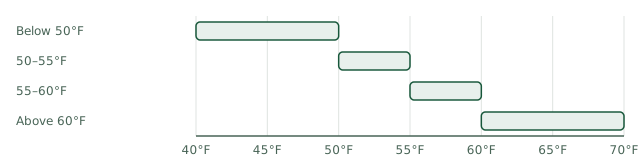
| Soil temperature (7-day average) | What it means | Your move |
|---|---|---|
| Below 50°F | Too cold for crabgrass to germinate; a barrier laid now starts wearing out before it has anything to stop. | Wait. Buy the product, watch the soil. |
| 50–55°F and warming | The window. Germination is close but hasn't started; a barrier laid now covers the whole germination season. | Apply now and water it in. |
| 55–60°F | Germination is underway, but it stretches over weeks — a late barrier still stops everything that hasn't sprouted. | Apply ASAP; expect some breakthrough. |
| Above 60°F | This year's crabgrass is up. A pre-emergent can't kill an emerged plant. | Switch to post-emergent control; be early next year. |
The pre-emergent soil-temperature bands are the same ones YardLedger's in-app crabgrass model fires on: the ~55°F germination threshold with the window opening ~5°F before it and grace extending ~5°F past it. The 7-day average matters — one warm afternoon is not a warm spring.
What else people ask about pre-emergent timing
- What soil temperature should I apply pre-emergent at?
- Crabgrass begins germinating once shallow soil holds around 55°F for several days, so the classic advice is to have your pre-emergent down and watered in as soil climbs through the low 50s. This tool watches a 7-day average of the shallow soil layer — the top couple of inches where the seeds actually sit — so one warm afternoon doesn't fake a window.
- Is it ever actually too late for pre-emergent?
- Pre-emergent can be too late. Once soil is solidly past germination (roughly 60°F and above), the year's crabgrass is already up, and a pre-emergent can't kill an emerged plant. In the 55–60°F band it's late-but-worth-it — germination stretches over weeks, so you still stop the stragglers. Past that, the honest answer is post-emergent control now and an earlier start next spring.
- Why not just use the forsythia-bloom rule, or apply the same weekend every year?
- Forsythia bloom is a folk indicator that correlates only loosely with soil temperature, and the calendar is worse — the real window can move three or four weeks between an early spring and a late one. Soil temperature is the actual driver of germination, which is why this tool (and the in-app timing model it shares an engine with) reads soil, not the calendar.
- Which products count as crabgrass pre-emergents?
- The common crabgrass pre-emergent active ingredients are prodiamine (Barricade), dithiopyr (Dimension), and pendimethalin (Pendulum, Scotts Halts); benefin, oryzalin, and indaziflam also appear. We don't sell or favor any of them. Whatever you choose, the product label is the law for the rate, your grass type, and watering-in — soil temperature only answers when.
- Will pre-emergent stop my grass seed too?
- Most conventional pre-emergents can injure seedlings or prevent establishment. Before seeding treated ground, follow the exact product's reseeding interval for the rate used; waits are often months, not weeks. Before treating newly seeded grass, follow its separate waiting, mowing and establishment requirements. Use a product at seeding only when its label allows your grass species, seed mixture, rate and timing. For crabgrass prevention while seeding cool-season grass, mesotrione products with new-seeding directions are an option only for the existing turf and seed mixture that product lists. Species and timing differ by product, especially for fine fescue; avoid over-application, particularly with perennial ryegrass.
- What about Poa annua and other winter weeds?
- Poa annua and the other winter annuals run on a different pre-emergent window entirely: they germinate in late summer and fall as soil COOLS (roughly down through 70°F), so their pre-emergent goes down in early fall — this page times the spring crabgrass window. The two jobs use overlapping products but opposite triggers.
- What if I'm checking months before my window — can this still tell me anything?
- Checking months before your window still gets an answer from this pre-emergent tool. A weather forecast only sees about two weeks, so from October the live series cannot reach next spring's crossing. When your ZIP falls in one of our curated metros we answer from that metro's typical window instead — the median date its shallow soil crossed ~50°F across ten years of records, with the earliest and latest years shown beside it so you can see how much a single year moves. That answer is labeled as a typical year, never as a reading; once the crossing comes inside the forecast horizon the page switches to your live soil temperature on its own.
- How accurate is this for my exact yard?
- The pre-emergent tool's soil temperatures are modeled values for your area from the Open-Meteo weather grid — the same source the app's paid timing model runs on — not a probe in your lawn. Bare, sunny, or south-facing soil runs a bit warmer than the model; shaded or irrigated soil a bit cooler. Use the verdict as a window, and when it says the window is open, sooner beats later.
Pre-emergent timing by metro
The typical window for every metro we hold soil records for — the median date shallow soil crosses ~50°F, with the observed range beside it. Useful for planning months ahead; the ZIP check above is what tells you where your soil is today.
Alabama
Alaska
Arkansas
Colorado
Connecticut
Delaware
Hawaii
Idaho
Illinois
Indiana
Iowa
Kansas
Kentucky
Louisiana
Maine
Maryland
Massachusetts
Michigan
Minnesota
Mississippi
Missouri
Montana
Nebraska
Nevada
New Hampshire
New Jersey
New Mexico
North Carolina
North Dakota
Oklahoma
Pennsylvania
Rhode Island
South Carolina
South Dakota
Tennessee
Vermont
Virginia
Washington
Washington, D.C.
West Virginia
Wisconsin
Wyoming

Where this guidance comes from
The university extension and public-agency publications listed here back specific statements on this page. Each publication says which statement it backs, so you can check the statement rather than take it on trust. Where a product label or your local extension office disagrees with anything here, follow the label or the extension office.
- Crabgrass
University of Minnesota Extension
Crabgrass starts germinating when soil reaches about 55°F, so a pre-emergent goes down before then and has to be watered in to work.
- Crabgrass Management in Lawns
University of Wisconsin–Madison Division of Extension (Wisconsin Horticulture)
Forsythia bloom is a rough indicator of pre-emergent timing, but soil temperature near 55°F is the real trigger, and rain or irrigation must carry the product into the soil.
- Biology and Management of Crabgrass
UMass Amherst Center for Agriculture, Food, and the Environment
Crabgrass germination follows soil temperature, beginning once the soil holds around 55°F for several days, which is why this page times the window by soil temperature.