
Every lawn
How to Get Rid of Dandelions — and What They Are Telling You
Kill dandelions in fall, roughly two to eight weeks before your first expected freeze, with a systemic herbicide labeled for your grass: the plant is moving sugars down into its taproot, and the herbicide travels with them. Pulling works only if you lift the whole foot-long root. Then thicken the lawn so new seed finds no bare ground.
A dandelion is a perennial with a taproot that goes down a foot or more, and almost everything that goes wrong with dandelion control follows from that one fact. Pulling the top off leaves the root, which regrows. Spraying a flowering plant in spring hits it when sap is moving upward, away from the root you need to reach. And a lawn with a lot of dandelions is telling you something before it is asking you for a herbicide: the seed is everywhere, in every lawn, every year — what varies is whether there is bare, compacted, or short-mown ground for it to land on. Killing this year's plants without changing that buys you one season.
What the dandelions are telling you, then what to do
- Step 1
Read what a heavy population is telling you first
Dandelion seed is windborne and universal — your neighbor's lawn is not the problem. Seed germinates where it reaches soil and light, so a heavy population means the lawn is thin, scalped, compacted, or all three. Dense turf mown at the top of its range shades the soil surface and dandelion seed simply does not establish in it. That is the control that keeps working in a year you do nothing else.
- Step 2
If you are digging: get the whole taproot, when soil is damp
Hand removal genuinely works on a handful of plants and is the right answer for a vegetable-garden edge or anywhere you do not want to spray. It only works if you get the root: a taproot snapped off partway down regenerates, often into two crowns rather than one. Use a narrow dandelion fork after rain or a watering, lever rather than pull, and fill the hole — a bare divot is a seedbed for whatever blows in next.
- Step 3
If you are spraying: fall beats spring, decisively
Spraying in fall rather than spring is the single highest-leverage decision in this dandelion guide. In autumn a perennial is moving carbohydrate down into the taproot for winter storage, and a systemic broadleaf herbicide is carried down with it to the tissue that actually has to die. In spring the flow is the other way and the same application often kills the top and leaves the root. If you can only treat once a year, treat in fall.
Check the label for your grass species by name — several routine broadleaf products injure St. Augustine and centipede — and for a temperature ceiling. Do not spray a drought-stressed lawn, and never treat where runoff can reach a storm drain or a waterway. Always read and follow the product label — it is the legal authority on rates, timing, and safety. These windows are regional estimates, not a prescription; defer to the label and your local extension office.
- Step 4
Spot-treat rather than blanket-spraying the lawn
A weed-and-feed spread over the whole lawn puts herbicide on the ninety-odd percent of it that has no dandelions, and ties the herbicide timing to a fertilizer timing that usually wants to be somewhere else in the year. A spot application to the plants you can see uses a fraction of the chemical, lets you pick the right week for each job, and does not ask you to feed the lawn on the herbicide's schedule.
- Step 5
Raise the mower — dandelion control starts here
A dandelion rosette lies flat and low, under the blade, which is why mowing does not control it directly. What mowing height changes is the light reaching the soil: turf cut at the top of its range shades out germinating seed, and turf cut short does not. Scalped lawns and dandelion problems are so reliably the same lawn that the mowing height is worth checking before the herbicide shelf.
- Step 6
Compaction and low fertility are the underlying cause
Dandelions tolerate compacted, low-fertility soil better than turfgrass does, so they win the ground where grass is struggling rather than out-competing healthy turf. Core aeration relieves the compaction; a soil test tells you whether pH or a nutrient deficiency is holding the grass back. Both attack the reason there was space, which is the only version of this that does not repeat annually.
- Step 7
Close the gaps in fall, once the herbicide interval has passed
Every dandelion you remove leaves a space, and something will fill it. A fall overseed into the thin areas is what decides whether that is grass or next year's weeds — but check the herbicide label first: many broadleaf products require a wait of several weeks before seeding, and a few block germination outright.
Dandelions: fall first, spring second
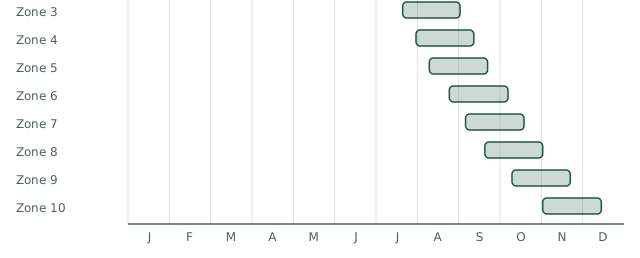
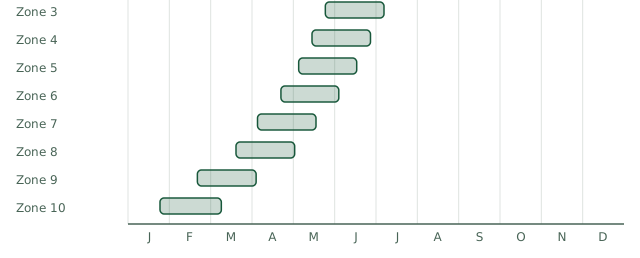
The windows below are timed off frost dates rather than the calendar — the same job happens more than a month apart across the country.
Both lawn types — the effective spray window is fall
A perennial moves sugars down to the root to overwinter, and a systemic herbicide moves with them. The same product on the same plant is markedly more effective now than in spring.
| USDA zone | Window |
|---|---|
| Zone 3 | July 21 – September 1 |
| Zone 4 | July 31 – September 11 |
| Zone 5 | August 10 – September 21 |
| Zone 6 | August 25 – October 6 |
| Zone 7 | September 6 – October 18 |
| Zone 8 | September 20 – November 1 |
| Zone 9 | October 10 – November 21 |
| Zone 10 | November 2 – December 14 |
The second-best window — spring, before it flowers
Treat the flat rosette, not the yellow flower. Once it has flowered the plant is putting its energy into seed, and a plant that has already gone to seed has done its damage for the year whatever you do to it.
| USDA zone | Window |
|---|---|
| Zone 3 | May 25 – July 6 |
| Zone 4 | May 15 – June 26 |
| Zone 5 | May 5 – June 16 |
| Zone 6 | April 22 – June 3 |
| Zone 7 | April 5 – May 17 |
| Zone 8 | March 20 – May 1 |
| Zone 9 | February 20 – April 3 |
| Zone 10 | January 25 – March 8 |
The windows in each table above are zone-level approximations from long-term freeze normals. A hardiness zone measures winter cold rather than frost dates, so check your own local dates — and where the job is driven by soil temperature, let that have the final say.
Set the fall window against your own first freeze
The table above is a zone average. Enter your ZIP for the NOAA freeze normals of the station we match to it — first fall freeze and last spring freeze both — free, no signup required.
Free · no signup · NOAA 1991–2020 normals
A heads-up for the next seasonal job in your area
We'll email you about three weeks before this ZIP's normal first freeze — while irrigation contractors still have slots, and before the backflow preventer is the part that freezes.
The blow-out reminder counts back from your metro's NOAA 1991–2020 median first freeze, not this year's forecast — a normal year, give or take a couple of weeks. Add your address and the reminder follows the live forecast for your own yard, with the checklist built around the zones and shut-offs you've mapped.
Pulling, mowing, and whether they harm the lawn
- What is the best time to kill dandelions?
- The best time to kill dandelions is fall, roughly two to eight weeks before your first expected freeze. Dandelions are perennials moving sugars down into the taproot to overwinter, and a systemic herbicide travels down with them to the root. Spring treatment on the flat rosette, before flowering, is the second-best window; spraying an open yellow flower is the least effective timing of the three.
- Does pulling dandelions work?
- Pulling dandelions works only if you get the entire taproot, which runs a foot or more down. A root snapped off partway regrows, sometimes into two crowns. Dig when the soil is damp, use a narrow fork and lever rather than pull, and fill the hole afterwards so the bare patch does not become a seedbed. For a handful of plants it is a perfectly good method.
- Why does my lawn have so many dandelions?
- A lawn gets so many dandelions because there is somewhere for the seed to land. Dandelion seed is windborne and reaches every lawn every year; what differs is whether the turf is dense and tall enough to shade the soil surface. A heavy population points at thin turf, a mowing height set too low, or compacted soil where grass struggles and dandelions do not.
- Are dandelions bad for my lawn?
- Dandelions compete with grass for light, water and nutrients, and a dense stand will thin the turf around it. But they are a symptom at least as much as a cause: they colonise ground the grass has already lost. They are also an early nectar source for bees, which is a real argument for spot-treating rather than blanket-spraying a lawn where the population is light.
- Will mowing get rid of dandelions?
- Mowing does not get rid of dandelions directly — the dandelion rosette sits flat, below the blade, and mowing off the flower stalks only delays seeding. Mowing height matters a great deal indirectly: cutting at the top of your grass's range shades the soil surface so new seed cannot establish. Mowing is prevention here, not removal.
Where this guidance comes from
The university extension and public-agency publications listed here back specific statements on this page. Each publication says which statement it backs, so you can check the statement rather than take it on trust. Where a product label or your local extension office disagrees with anything here, follow the label or the extension office.
- Dandelions
University of Minnesota Extension
Fall is the most effective time to spray dandelions, because the plant is moving nutrients down into its taproot for winter and the herbicide moves with them.
- Pest Notes: Dandelion (UC ANR Publication 7469)
UC Statewide IPM Program (UC IPM)
Digging only works if you get the whole taproot, because a dandelion can regrow from a piece of root left in the ground.
- Dandelions in Lawns
UMass Amherst Center for Agriculture, Food, and the Environment
A dense, well-fed lawn is the lasting control, and low fertility is one of the conditions that lets dandelions take over.
