
Every lawn
Lawn Soil Test: How to Take One, and What the Numbers Mean
To test lawn soil, pull ten to fifteen plugs across the area to the depth your lab asks for, mix them in a clean plastic bucket, and mail the sample to your state extension lab — ideally in fall. Read pH first, then act on phosphorus and potassium as the lab recommends; any nitrogen reading is only a snapshot.
Almost every lawn fertility recommendation you will read — including YardLedger's — comes with a hedge: a soil test would tell you. The hedge exists because the two things that decide whether fertilizer works are invisible from above ground. Soil pH controls whether nutrients that are present are actually available to the plant, and phosphorus and potassium levels decide whether adding more of them does anything at all. A test costs roughly what one bag of fertilizer costs, is good for three years, and is the only way to stop applying nutrients your lawn already has or lime it does not need.
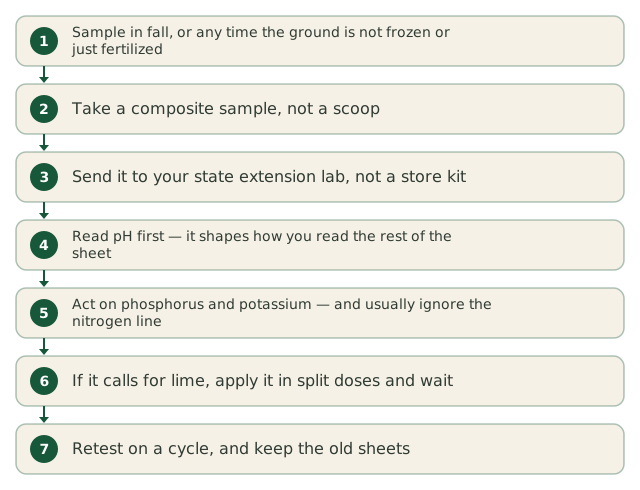
From sampling to acting on the results
- Step 1
Sample in fall, or any time the ground is not frozen or just fertilized
Fall is the usual recommendation for soil sampling for a practical reason rather than an agronomic one: labs are quiet, results come back in time to plan next season, and lime — if you need it — is slow, so a fall application starts working over the winter. On an established lawn, where lime sits on the surface, a large correction can take more than one season, so plan on retesting rather than on a finish date. Any time works apart from immediately after a fertilizer or lime application, which reads as a spike that is not representative.
- Step 2
Take a composite sample, not a scoop
Pull ten to fifteen plugs at random across the area, to the depth your lab's instructions give — protocols differ, and some sample established turf shallower than a new seeding (the University of Minnesota lab asks for 0–3 inches under established grass and 0–6 under new) — and mix them in a clean plastic bucket. A single scoop measures one square inch of a lawn that varies. Sample front and back separately if they were built or treated differently, and keep any problem area as its own sample rather than blending it into the average, because blending is exactly what hides it.
Use a plastic bucket and clean tools. Galvanised steel contaminates a zinc reading and brass a copper one.
- Step 3
Send it to your state extension lab, not a store kit
The mail-in test from a land-grant university lab is the one worth having. Panels differ by lab: pH, phosphorus and potassium are the usual core, while organic matter, buffer pH (often run only when the soil is acid enough to need lime) and cation exchange capacity are standard at some labs and optional at others, so check the panel before you order. The part that matters most is the recommendation, calibrated to your region's soils and the lab's own methods. A hardware-store color kit gives you a pH band and nothing you can act on.
- Step 4
Read pH first — it shapes how you read the rest of the sheet
Most lawn grasses do well somewhere around 6.0–7.0, but the target is species-specific and the exceptions matter: centipedegrass performs best at about 5.5–6.0 and Clemson advises liming it only below pH 5.0, so "correcting" a centipede lawn up to 6.5 is a mistake, not a fix. Bahiagrass and the fine fescues also prefer the acid end. Tell the lab which grass you grow and read its recommendation against that grass. Direction matters as much as the number: as pH falls, phosphorus availability drops and so does molybdenum, while iron, manganese, zinc and copper become MORE available — to the point of toxicity in strongly acid soil — and as pH climbs past neutral the same micronutrients lock away instead, which is why high-pH yellowing is usually an iron problem rather than a nitrogen one. Where the lab recommends lime or sulfur, follow it for your grass. A naturally alkaline, calcareous soil can resist a lasting or economical correction, though, so there the lab's advice on grass choice and targeted nutrients matters more than chasing the number before you feed.
- Step 5
Act on phosphorus and potassium — and usually ignore the nitrogen line
Phosphorus and potassium are stable enough in soil to be worth measuring, so the report tells you something real: most established lawns test sufficient in phosphorus and need none. Nitrogen is the opposite — it moves and transforms too quickly for a snapshot to forecast a season, which is why nitrogen is budgeted by grass and season rather than by test, and planned at about 1 lb per 1,000 sq ft or less per feeding (a conservative default, not a universal limit). Some labs do interpret a current nitrate reading for established turf, as a cue to hold off a feeding; where yours does, use its reading that way.
Several states restrict phosphorus on established lawns unless a soil test documents a deficiency — the test is often the legal basis for applying it at all. Local fertilizer rules can be stricter than this and can override it: several states and counties set a lower per-application limit, cap the soluble (quick-release) fraction separately, require a share of slow-release nitrogen, or ban applications outright during a seasonal blackout. Check your state or county rules before you spread. Always read and follow the product label — it is the legal authority on rates, timing, and safety. These windows are regional estimates, not a prescription; defer to the label and your local extension office.
- Step 6
If it calls for lime, apply it in split doses and wait
Lime works slowly and cannot be rushed: it takes months to move pH measurably — longer on established turf, where it is not worked into the soil — and overshooting is far harder to reverse than undershooting. Where a large correction is recommended, split it into as many applications as the lab and the product label call for, since how much one pass can carry depends on the material, your region and whether the lawn is established. Water each in, and retest before adding more rather than assuming the first pass did nothing.
- Step 7
Retest on a cycle, and keep the old sheets
Every two to three years is the usual soil-testing interval for a settled lawn, and your lab or extension office may say otherwise for your soil — follow theirs. Test more often when something is actually in motion: while a pH correction is underway, through establishment or renovation, or when you are troubleshooting a problem you have not explained. Those extra tests are how you find out whether the lime worked. One test is a reading; three are a trend, so keep the reports — they show whether pH actually moved and whether your phosphorus is drifting down under the clippings you return.
Got the numbers — now what goes down, and when?
A soil test reports your pH and the nutrient levels your lab measures, rated on that lab's own scale. Enter your grass type and ZIP in the free schedule generator for the month-by-month feeding plan it fits into, with the nitrogen already budgeted for your grass — no signup required.
Open the schedule generatorWant the next seasonal job flagged for you?
We'll email you about three weeks before this ZIP's normal first freeze — while irrigation contractors still have slots, and before the backflow preventer is the part that freezes.
The blow-out reminder counts back from your metro's NOAA 1991–2020 median first freeze, not this year's forecast — a normal year, give or take a couple of weeks. Add your address and the reminder follows the live forecast for your own yard, with the checklist built around the zones and shut-offs you've mapped.
Kits, timing, pH and the nitrogen line
- How often should I do a lawn soil test?
- A soil test every two to three years suits an established lawn in a steady routine — check what your own lab or extension office recommends, since intervals vary by soil and by state. Test more often while something is changing: during a pH correction, through establishment or renovation, after a switch in fertilizer program, or when you are troubleshooting a problem you have not explained. Annual testing on a settled lawn that is not being corrected has little to tell you; annual testing while you are moving pH is how you find out whether it is working.
- What pH should lawn soil be?
- The right soil pH for a lawn depends on the grass, and "6.0–7.0 for everything" is the common answer that gets centipede lawns damaged. Most cool-season grasses and most warm-season grasses do sit near 6.0–7.0; centipedegrass prefers about 5.5–6.0 and should only be limed below pH 5.0, and bahiagrass and fine fescue also lean acid. Availability shifts in both directions as pH moves: phosphorus is least available at the extremes, while iron, manganese and zinc become more available as soil acidifies and lock up as it alkalizes. Ask your lab for the target for your species rather than a generic band.
- Are hardware-store soil test kits any good?
- Hardware-store soil test kits are adequate for a rough pH reading. For anything you would spend money acting on, no — they do not give reliable phosphorus and potassium levels, no cation exchange capacity or organic matter, and no recommendation calibrated to your region. Your state extension lab charges very little for the version that answers the question.
- When is the best time to take a soil sample?
- Fall is the best time to take a soil sample, mostly for practical reasons: labs turn results around faster, you get them in time to plan, and lime applied in fall starts working over the winter, though a large correction can take more than one season. Avoid sampling within a couple of months of a fertilizer or lime application, which temporarily skews the reading.
- Does a soil test tell me how much nitrogen to apply?
- A soil test does not tell you how much nitrogen to apply over the season. Nitrogen moves through soil and transforms too fast for a snapshot to predict what will be there when the grass needs it, so many labs leave it off a routine panel or report it as a current reading only. Some labs interpret a current nitrate result for established turf — as a cue to hold a feeding, for example — and where yours does, use it that way. The season's nitrogen is budgeted from your grass type, region, goals, whether you return clippings, and how you irrigate — with a conservative planning default of about 1 lb per 1,000 sq ft in any one feeding, not a universal limit. Local fertilizer rules can be stricter than this and can override it: several states and counties set a lower per-application limit, cap the soluble (quick-release) fraction separately, require a share of slow-release nitrogen, or ban applications outright during a seasonal blackout. Check your state or county rules before you spread.
Where this guidance comes from
The university extension and public-agency publications listed here back specific statements on this page. Each publication says which statement it backs, so you can check the statement rather than take it on trust. Where a product label or your local extension office disagrees with anything here, follow the label or the extension office.
- Soil Testing
Penn State Extension
A lawn sample should be a composite of cores taken at random across the area and mixed in a plastic bucket, not a single scoop.
- Soil Testing for Home Lawns, Gardens and Wildlife Food Plots (Circular 896)
University of Georgia Cooperative Extension
Fall is the usual time to sample for practical reasons, and an established lawn is typically retested every two to three years.
- Soil Testing (HGIC 1652)
Clemson Cooperative Extension
Soil pH governs whether nutrients in the soil are available to the grass, and lime takes months to move pH, which is why the page reads pH first and limes in fall.
