
Every lawn
Crabgrass Control: Which Option Is Still Open to You
Before soil at seeding depth holds in the mid-50s°F for several days, put down a pre-emergent labeled for your grass — and not on ground you are seeding unless its label allows it. Young crabgrass, before it tillers, still responds to a labeled post-emergent; after that control gets harder, so mow high and thicken the lawn in fall.
Crabgrass is an annual. Every plant you see this year germinated this year from seed left by last year's plants, dies at the first hard freeze whatever you do, and drops thousands more seeds before it goes. That single fact decides the whole strategy: the war is fought against next year's germination, not against the plants in front of you, and the only question worth asking in any given week is which control is still available. Before the soil warms, a pre-emergent barrier. After it warms but before the plants tiller, a post-emergent. After that, nothing chemical that is worth the risk to your lawn — and the real work becomes making the lawn thick enough that next spring's seed never gets light.
Which option is still open where you are?
Everything on this page turns on whether your soil has already crossed 55°F. Enter your ZIP in the free pre-emergent check for the median crossing near you, how much of the window is left, and how far the earliest and latest years have run — no signup required.
Check my pre-emergent windowWant a heads-up when the next seasonal job is due?
We'll email you about three weeks before this ZIP's normal first freeze — while irrigation contractors still have slots, and before the backflow preventer is the part that freezes.
The blow-out reminder counts back from your metro's NOAA 1991–2020 median first freeze, not this year's forecast — a normal year, give or take a couple of weeks. Add your address and the reminder follows the live forecast for your own yard, with the checklist built around the zones and shut-offs you've mapped.
Your options, from soil temperature to fall thickening
- Step 1
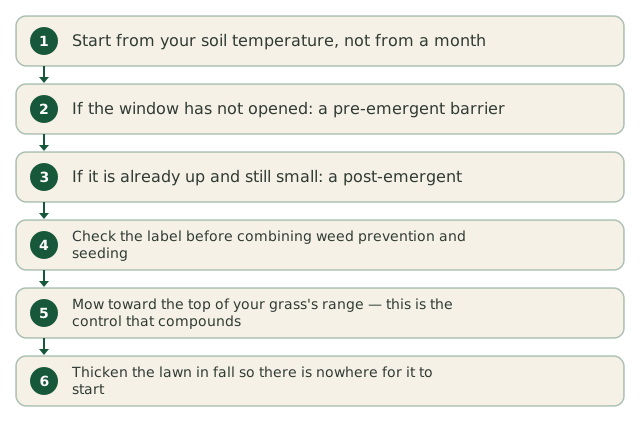
Start from your soil temperature, not from a month
Crabgrass germinates as soil at seeding depth holds in the mid-50s°F for several consecutive days, and that crossing moves by more than two months across the country and by a couple of weeks between years in the same place. Temperature is the strongest single signal, not a switch: soil moisture, a bare south-facing strip, the species and ecotype in your yard, and your product's residual all move the real date, which is why the honest answer is a window rather than a number. Going in late is the most common way the application is wasted — a barrier does nothing for the seedlings already up, though germination runs in cohorts over weeks, so a late application can still prevent the ones behind them. The free pre-emergent check gives the median crossing and the observed spread for the metro nearest you.
- Step 2
If the window has not opened: a pre-emergent barrier
A pre-emergent does not kill seed. It leaves a thin chemical layer in the top of the soil that stops the seedling as it emerges through it, which is why it has to be down and activated according to the label before germination. Dethatching and heavy soil disturbance can affect control, but core aeration does not automatically undo it. Where practical, finish cultivation before application. Whether the product supports a split program, at what interval, and against what annual maximum are label questions and they differ by active ingredient: some products are labeled for a split that covers a longer germination window than a single pass, and some are a single application for the year. Pick the product first, then read its directions — do not plan a second pass on a general rule.
Never exceed the label's annual total by splitting an application — where a split is permitted it is a division of the same yearly budget, not an addition to it, and the labeled interval is the one to use. Always read and follow the product label — it is the legal authority on rates, timing, and safety. These windows are regional estimates, not a prescription; defer to the label and your local extension office.
- Step 3
If it is already up and still small: a post-emergent
Young crabgrass, before it has tillered out into the wide flat rosette, is genuinely controllable with a selective post-emergent — and dithiopyr is labeled for that stage too, giving early-postemergence control up to tillering while still leaving a barrier behind it. Once the plant has tillered, the same product at the same rate frequently only burns it back and the plant recovers; some labels carry a higher rate for larger plants, so check yours rather than assuming nothing is left to try. Heat matters as much as size: several of these products injure cool-season lawns above roughly 85°F, so an August rescue application often costs more turf than it saves.
Check the label for a temperature ceiling and for your grass species by name — St. Augustine and centipede are sensitive to products that are routine on bluegrass. Always read and follow the product label — it is the legal authority on rates, timing, and safety. These windows are regional estimates, not a prescription; defer to the label and your local extension office.
- Step 4
Check the label before combining weed prevention and seeding
Many pre-emergents can injure new grass. Choose your seeding date and weed-control product together, using its reseeding and new-turf directions.
Most conventional pre-emergents can injure seedlings or prevent establishment. Before seeding treated ground, follow the exact product's reseeding interval for the rate used; waits are often months, not weeks. Before treating newly seeded grass, follow its separate waiting, mowing and establishment requirements. Use a product at seeding only when its label allows your grass species, seed mixture, rate and timing. For crabgrass prevention while seeding cool-season grass, mesotrione products with new-seeding directions are an option only for the existing turf and seed mixture that product lists. Species and timing differ by product, especially for fine fescue; avoid over-application, particularly with perennial ryegrass.
- Step 5
Mow toward the top of your grass's range — this is the control that compounds
Crabgrass seed needs light at the soil surface to germinate. Turf mowed at the top of its range shades that surface; turf mowed short does not, which is why a scalped lawn and a crabgrass problem are so often the same lawn. This is the cheapest control available, it costs nothing, and it is the one that makes next year easier rather than just this year survivable.
- Step 6
Thicken the lawn in fall so there is nowhere for it to start
Crabgrass colonises bare soil — along drives and walks where the surface bakes, in thin shade, in the strip the mower scalps. A fall overseed into those specific areas removes the opportunity rather than treating the symptom, and a thick stand is the only control that keeps working in a year you forget to do anything else.
Too late? Seeding? Aerating? The usual questions
- When should I apply crabgrass pre-emergent?
- Apply crabgrass pre-emergent before soil temperatures at seeding depth reach about 55°F for several consecutive days — which is a date that moves by two months across the country and by a couple of weeks year to year in one place. Enter your ZIP in the free pre-emergent check for the median crossing near you and the earliest and latest it has been observed.
- Is it too late for crabgrass pre-emergent?
- Whether it is too late for a crabgrass pre-emergent depends on what has already come up, and "too late" is less absolute than it sounds. A barrier does nothing to plants that are already up — but crabgrass germinates in cohorts over several weeks, so a residual product going down now can still prevent the ones behind the first flush. Some actives also work in both directions: dithiopyr is labeled for early-postemergence crabgrass control up to tillering (roughly five leaves, before the plant fans out), so it can catch young seedlings and hold a barrier at the same time — check that your product lists that use, the growth stage and your grass species. Once the stand has tillered, switch to a selective post-emergent labeled for the job, and attack next year's seed bank by mowing high and overseeding in fall.
- Will crabgrass die on its own?
- Every crabgrass plant dies on its own at the first hard freeze, because crabgrass is an annual. The freeze is not the win it sounds like: each plant drops thousands of seeds first, and those seeds stay viable in the soil for years. Doing nothing costs you next spring rather than this fall.
- Can I put down crabgrass preventer and grass seed together?
- Most conventional pre-emergents can injure seedlings or prevent establishment. Before seeding treated ground, follow the exact product's reseeding interval for the rate used; waits are often months, not weeks. Before treating newly seeded grass, follow its separate waiting, mowing and establishment requirements. Use a product at seeding only when its label allows your grass species, seed mixture, rate and timing. For crabgrass prevention while seeding cool-season grass, mesotrione products with new-seeding directions are an option only for the existing turf and seed mixture that product lists. Species and timing differ by product, especially for fine fescue; avoid over-application, particularly with perennial ryegrass.
- Does aerating remove crabgrass pre-emergent?
- If both jobs are needed, core-aerate before applying pre-emergent where practical. Research generally finds that core aeration afterward does not reduce pre-emergent crabgrass control; it does not automatically waste the application. Check the exact product label and local guidance, especially if seeding: many products inhibit grass establishment.
Where this guidance comes from
The university extension and public-agency publications listed here back specific statements on this page. Each publication says which statement it backs, so you can check the statement rather than take it on trust. Where a product label or your local extension office disagrees with anything here, follow the label or the extension office.
- Lawn and Turfgrass Weeds: Smooth Crabgrass and Large Crabgrass
Penn State Extension
Crabgrass starts germinating once the top of the soil holds around 55°F for several days, so a pre-emergent has to be down before that crossing to do its job.
- Pest Notes: Crabgrass (UC ANR Publication 7456)
UC Statewide IPM Program (UC IPM)
Dithiopyr and similar pre-emergents can also catch very young crabgrass seedlings, but not plants that have grown past that early stage.
- Biology and Management of Crabgrass
UMass Amherst Center for Agriculture, Food, and the Environment
Mowing toward the top of your grass's range shades the soil surface, which is the cheapest crabgrass control this page recommends.
