
Before the first hard freeze
How Much Does It Cost to Winterize a Sprinkler System?
A professional sprinkler blow-out typically costs $50–250 for a residential system, driven mainly by zone count and region, with large properties and systems with an RPZ at the top. A DIY blow-out still needs a compressor with real airflow, the right fittings and an afternoon. Skipping it risks freeze repairs that typically run $170–$2,500+.
A professional sprinkler blow-out typically runs $50–250, with zone count and region driving most of the spread — a four-zone suburban system at the bottom, a large multi-zone property with an RPZ at the top. Doing it yourself is not free: it needs a compressor with real airflow, the right fittings, and an afternoon. The number that makes the decision, though, is on the other side of the ledger — freeze repairs typically run $170–$2,500+, and the backflow preventer alone can account for most of a bill in that range.
Working through it
- Step 1
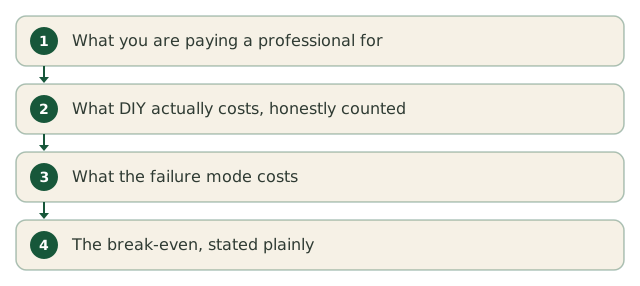
What you are paying a professional for
The $50–250 range buys a machine with the airflow to actually clear the laterals, someone who has seen your device before, and — the part that is easy to undervalue — liability for anything that breaks during the process. Quotes usually scale with zone count; ask how many zones the price covers and what the per-zone overage is before you book.
- Step 2
What DIY actually costs, honestly counted
A day rental on a compressor with usable airflow is often close to the price of a professional visit by itself, plus the blow-out adapter and fittings, plus your afternoon. Buying a machine large enough only makes sense across several seasons or several properties. Where DIY genuinely wins is a system built with drain valves, but component-specific drainage and any required service still need to be checked.
- Step 3
What the failure mode costs
Sprinkler freeze repairs land anywhere in the $170–$2,500+ range. A cracked lateral in open lawn is at the cheap end; a split backflow assembly, a cracked manifold, or a run under a driveway is at the other, and a damaged assembly may also need re-testing or re-certification depending on your jurisdiction. It is worth noticing that the cheapest repair still costs about what a blow-out does.
- Step 4
The break-even, stated plainly
Hire out sprinkler winterization if you have no compressor with real airflow, no drain valves, or an RPZ you would rather not learn on. Do it yourself if the system was built to drain, or if you already own a machine in the right class and have done it before. Everything else is close enough that convenience decides it.
When does your first freeze usually arrive?
The right sprinkler winterization method depends on your equipment, and the planning window depends on your location. Enter your ZIP for the NOAA freeze normals of the station we match to it — free, no signup required.
Free · no signup · NOAA 1991–2020 normals
Where this job usually trips people up
- How much does a sprinkler blowout cost?
- A sprinkler blowout typically costs $50–250 for a residential system, driven mainly by zone count and region. Larger properties and systems with an RPZ sit at the upper end.
- Is it cheaper to winterize sprinklers yourself?
- Winterizing sprinklers yourself is only sometimes cheaper. If your system has manual or automatic drain valves, DIY is free. If it needs a blow-out and you have to rent a compressor with real airflow, a day rental plus fittings often lands close to what a contractor charges — and the contractor carries the risk.
- Is winterizing worth it if I only get a few freezes a year?
- Winterizing is usually worth it even with only a few freezes a year, because the exposure is not proportional to how many freezes you get. One long, cold night with water still in an above-ground backflow preventer can be enough, and the repair range ($170–$2,500+) does not shrink because it was the only cold night of the winter. In genuinely freeze-free climates it is unnecessary — that is a different situation from "we rarely freeze".
- Does homeowners insurance cover frozen sprinkler pipes?
- Homeowners insurance frequently does not cover frozen sprinkler pipes, because insurers commonly treat freeze damage to an un-winterized irrigation system as a maintenance failure rather than a covered peril. Policies vary and this is not insurance advice — read yours, or ask your agent, before assuming you are covered.
Get the reminder without scrolling back up
Enter your ZIP and we’ll set up the same reminder the ZIP tool higher on this page offers, timed to when it actually matters for your area.
Free · no signup · NOAA 1991–2020 normals
Check the instructions for your equipment
The equipment-manufacturer guides below explain the differences discussed here. Use the current instructions for your exact model, size and installation; an example for another device is not a procedure for yours. If you cannot verify them, use qualified service before connecting air or opening parts.
- FEBCO 765 winterization — IS-F-765-Winterization 2043 (2020), pages 1–2
- Zurn 950/950XL and 975/975XL freeze protection — Rev. C (July 2017)
- FEBCO 850/LF850 Small and 860/LF860 Small (½–2 in.) — 2344 (2023), pages 1–2
- Watts 800M4/LF800M4 — RP/IS-800M4 2409 (2024), Freeze Protection, page 2
- Rain Bird homeowner winterization guide — pressure and valve drainage, pages 3–6
- Hunter winterization guidance — component limits and air precautions
Where this guidance comes from
The university extension and public-agency publications listed here back specific statements on this page. Each publication says which statement it backs, so you can check the statement rather than take it on trust. Where a product label or your local extension office disagrees with anything here, follow the label or the extension office.
- Home Sprinkler Systems: Preparing Your Sprinkler System for Winter (Fact Sheet 4.719)
Colorado State University Extension
Preparing the system in the fall costs far less than repairing frozen fittings, pipe, valves and heads in spring — the trade the page's cost comparison is built on.
- Properly preparing irrigation systems for winter
University of Minnesota Turfgrass Science
What a professional brings is a commercial compressor with far more airflow than most homeowner machines, which is why DIY blowout needs real airflow, not just pressure.
- Irrigation System Maintenance
Utah State University Extension
Whether DIY is cheap depends on the system: one with drain valves can be drained, while one that needs pressurized air may be better handed to a professional.
