
Warm-season grass
Kikuyugrass: Armyworms
Worried about armyworms on your Kikuyugrass lawn? Green to brown in days — the late-summer caterpillar that eats lawns. This guide takes the general diagnosis and tunes it for Kikuyugrass — the signs to look for, what to do first, and how a warm-season lawn recovers — kept safety-first, with the product label as the final word.
What this means for Kikuyugrass
Kikuyugrass: The fast, tough, aggressive grass of coastal California. As a warm-season grass at its peak in summer, when it browns or thins the cause is usually a specific pest, disease, or drought — not the grass simply giving out. Armyworms chew the leaf blades, not the roots, which is why a lawn can go from green to brown in days and still recover once they've moved on. Identifying the actual culprit is the whole game: fix that and a healthy stand normally bounces back. Worth knowing about Kikuyugrass generally: forms a dense, tough turf.
How to tell on a Kikuyugrass lawn
- Large areas thinning or browning very fast — sometimes overnight — often spreading like a moving front.
- Up close, the blades are chewed, ragged, and see-through rather than evenly drought-browned.
- Lots of birds suddenly working the lawn — they're eating the caterpillars.
- Green-to-brown striped caterpillars (up to ~1.5") with a pale inverted 'Y' on the head, most active at dawn and dusk.
What to do
- Step 1
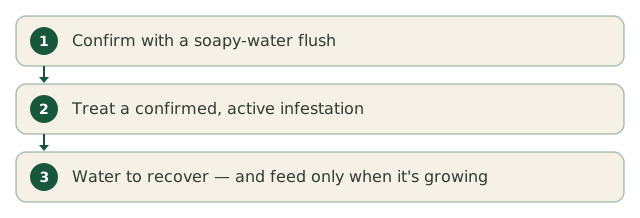
Confirm with a soapy-water flush
Before you treat for armyworms, confirm them: mix a couple of tablespoons of dish soap into a gallon of water and pour it over a square yard where green meets brown. Armyworms usually surface within minutes; an empty flush isn't proof they're absent. Check early morning or evening, when they feed — they hide near the soil in the heat of the day.
- Step 2
Treat a confirmed, active infestation
If the flush finds enough caterpillars to explain the damage, choose an insecticide labeled for armyworms and apply it in the late afternoon or evening, when the caterpillars are feeding — smaller, younger larvae are far easier to control. Treat the damaged area and a buffer around it.
Always read and follow the product label — it is the legal authority on rates, timing, and safety. These windows are regional estimates, not a prescription; defer to the label and your local extension office.
- Step 3
Water to recover — and feed only when it's growing
Once the worms are gone, keep the lawn watered so it can rebuild. If it's actively growing — not heat- or drought-stressed, and not a cool-season lawn in summer — a light feeding helps it bounce back; otherwise hold the fertilizer and let water do the work. Bermuda and other spreading grasses usually regrow from surviving crowns, at a pace set by the damage and weather; bunch-type lawns like tall fescue may need bare spots reseeded in the fall.
Plan any feeding at about 1 lb of nitrogen per 1,000 sq ft or less (a conservative default, not a universal limit), never feed a heat- or drought-stressed lawn, and check whether your state or county sets a lower limit. Always read and follow the product label — it is the legal authority on rates, timing, and safety. These windows are regional estimates, not a prescription; defer to the label and your local extension office.
Not sure it's Armyworms?
On Kikuyugrass, armyworms can look like several other problems. Answer a few quick questions in the free YardLedger diagnosis tool and the tool narrows what your Kikuyugrass lawn is actually showing — and the fix for each — no signup required.
Diagnose my lawnHow Kikuyugrass recovers
Kikuyugrass spreads and self-repairs, so once the cause is handled, small thinned or damaged areas usually fill back in on their own with steady watering and time — you rarely need to reseed. One thing working in Kikuyugrass's favor: fast-growing and very wear-tolerant — recovers quickly from traffic. Armyworms mainly eat blades, so a lawn often regrows without a reseed — though heavy feeding can injure crowns, and spots that don't regrow need repair.
Safety first on Kikuyugrass
Kikuyugrass is a US federal noxious weed and is regulated, restricted, or outright prohibited in many states — confirm it is legal in your area (check your state department of agriculture) before planting, and contain it so it doesn't spread to neighbors or wildland. Plan each feeding at about 1 lb of nitrogen per 1,000 sq ft or less (a planning default).
Treat only a confirmed, active infestation, and apply it in the late afternoon or evening when the caterpillars are actually feeding — smaller larvae are far easier to control. And more generally, Kikuyugrass has this going for it: good heat and drought tolerance in mild coastal climates. Always read and follow the product label — it is the legal authority on rates, timing, and safety. These windows are regional estimates, not a prescription; defer to the label and your local extension office.
Preventing it next season
Armyworms blow in on late-summer moth flights, so for a home lawn the key is scouting. Watch for sudden bird activity or a neighbor's lawn going brown in late summer, and check early: small larvae caught early are far easier to stop than a full-grown army.
